

Thank you for Subscribing to Cannabis Business Insights Weekly Brief


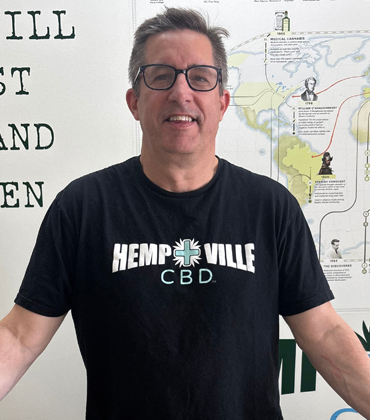 Ben Couey, Founder
 Answering that question requires looking at the reality already in front of policymakers. Hemp products are widely available, customers are buying them and retailers are selling them, yet the standards governing those sales vary extensively. In one store, a shopper may find transparent labeling, verified testing, age controls and staff who understand what they are offering. At a gas station or vape shop down the road, the same shopper may encounter little more than a price tag. Many of those outlets sell unverified or mislabeled products with minimal scrutiny and inconsistent attention to buyer age limits.
That unevenness shapes how many people—including lawmakers—view the industry. It is a problem worth solving.
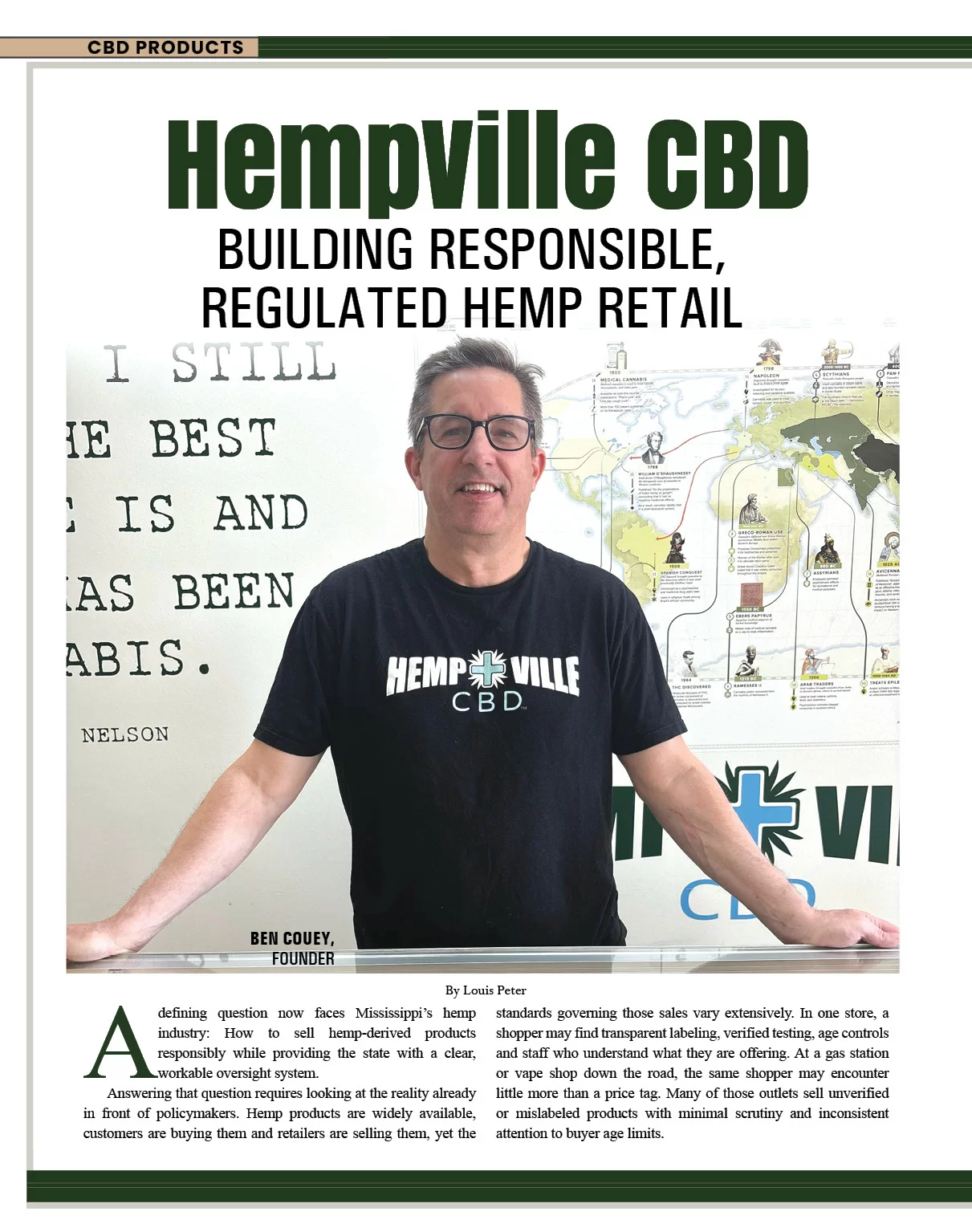
Ben Couey, founder of HempVille CBD in Southaven, believes structure is the answer. He argues that the hemp market should operate under rules that separate responsible retailers from careless ones.
“We don’t want an unregulated industry. We want a responsible one, built on testing, education and accountability,” says Couey.
Under that standard, customers understand what they are buying, know that products are verified and labels are accurate, retailers are accountable for what they place on their shelves and age limits are enforced.
Couey built HempVille CBD around that goal. It offers lab tested hemp derived products at its Southaven location and online shop. Customers visit for support with sleep, stress and everyday discomfort. The environment functions less like a retailer and more like a guided wellness setting, where staff help customers understand how to select a product, how to use it responsibly and when to consult a physician. It is a model that demonstrates how regulated hemp retail can function well, be transparent and be centered on consumer protection.
A Personal Reason for a Different Standard
Couey’s interest in hemp wellness began with an experience that stayed with him. After his mother passed away in 2009, he learned she had been prescribed 13 medications, many taken to counteract the side effects of others. The discovery sharpened his awareness of how overwhelmed people can feel when searching for relief.
When CBD and hemp derived products were gaining attention, Couey saw an opportunity to help people navigate those choices. He opened HempVille CBD in August 2019, at a time when public understanding of hemp products was still limited. Some days brought no customers at all. He came to see the challenge as one of education.
“I’m a retired schoolteacher, so I approached this business with an educator’s mindset. I saw a gap in understanding and built HempVille CBD around helping people make informed choices,” says Couey.
That purpose lives in the store’s name. ‘Hemp’ stands for Help educate more people. ‘Ville’ signals community, the idea that people in the same place should look out for one another. That philosophy guides the business every day.
Education Before the Sale
A first time customer may arrive with a specific concern or no starting point at all. Some prefer to browse quietly. Others need guidance but don’t know how to ask for it. Staff are trained to determine the customer’s need through conversation.
I’m a retired schoolteacher, so I approached this business with an educator’s mindset. I saw a gap in understanding and built HempVille CBD around helping people make informed choices.
Someone who doesn’t smoke hears about non inhalable formats first. A customer worried about workplace testing learns that hemp-derived products can affect the test results. Anyone taking prescription medication is urged to speak with a physician before starting a hemp regimen. The boundary remains well-defined. Employees are not clinicians. They do not diagnose or prescribe. Their role is to help customers understand what they are buying and what questions to ask before using it.
One situation illustrated why that matters. A woman arrived with a CBD tincture purchased elsewhere and said she felt dizzy after taking it. Staff asked about dosage, timing and medications. She was taking blood pressure medication in the morning and had taken the tincture at the same time. CBD can slow the metabolism of certain medications, which can intensify their effects. Staff encouraged her to speak with her physician and explained why timing matters. The right question protected the customer more than any sale could.
Testing as a Retail Responsibility
HempVille CBD does not manufacture its own products, making product selection a critical responsibility. A supplier earns shelf space only with a track record of professional formulation and transparent documentation. Every product must arrive with a certificate of analysis (COA) from an independent lab, proof that the contents match the label.
 Packaging matters as much as testing. A customer once brought in a Delta 9 gummy from another store. There was almost no information on the label; no dosage level, ingredient list or way to know whether the piece contained a mild amount or an overwhelming one. HempVille CBD would never carry a product that leaves customers guessing.
Another supplier offered a gummy, describing it as balanced and smooth. The COA told a different story. The actual CBD content fell well short of the label, and a cheaper filler cannabinoid made up the difference, unlisted anywhere on the package. Because of the discrepancy, the product never reached HempVille’s shelf. Verification made the difference. When testing and honest labeling become standard, the market becomes safer.
Training That Sets a Higher Bar
New hires train for several months before working the counter. They learn the point of sale system, then study cannabinoids such as CBD, CBG and CBN, as well as how different compounds affect the body. They learn product formats, strain differences, supplier standards, COA review, dosage conversations and common customer concerns. Most importantly, they learn how to listen.
 Employees are trained to understand why a customer came in and what problem they hope to solve. That understanding may lead to a recommendation, a caution or a suggestion to consult a physician first. The result is a calmer, more informed retail experience.
“Customers often describe HempVille CBD as a place where staff know their names, answer questions and make them comfortable recommending it. That trust comes from standards and repetition. It shows how hemp retail can earn public confidence when accountability shapes the practice,” says Couey.
Customer Feedback as Quality Control
Feedback on product performance, usability, taste and value helps determine whether an item earns long term shelf space. Staff ask returning customers how a product worked and whether it met expectations.
Supplier samples follow the same path. When a supplier introduces a new product, HempVille CBD shares it with customers who already use that category and gathers honest feedback before deciding whether to stock it. Testing verifies product ingredients. Customer experience reveals how it performs in daily life. Responsible retail relies on both.
From One Store to a Statewide Conversation
Couey’s work now extends beyond the storefront. Mississippi’s hemp businesses have spent years navigating legislation that could restrict or eliminate hemp derived products. That uncertainty wears on responsible retailers who want to operate under clear rules. Unsafe products remain in circulation and businesses like HempVille CBD show that the issue can be addressed.
Couey formed a lobbying team in 2023. In 2025, he helped organize the Mississippi Southern Hemp Coalition, a nonprofit created to provide year round political representation and education for the state’s hemp industry. He supports rules that remove unsafe products, reduce underage access, require accurate labeling, verify testing and set clear expectations for retailers.
-
Customers often describe HempVille CBD as a place where staff know their names, answer questions and make them comfortable recommending it. That trust comes from standards and repetition. It shows how hemp retail can earn public confidence when accountability shapes the practice.
HempVille CBD argues that the answer is guardrails, not elimination. A licensing model, similar to the system Mississippi already uses for alcohol, could require products with intoxicating effects to be sold through licensed retailers that meet consistent standards for employee training, age verification, product testing, labeling and consumer education. The concern is not the retail format itself. It is whether every seller is equipped and accountable to protect consumers. Under that framework, intoxicating hemp-derived products would move out of gas stations and convenience stores unless those outlets met the same licensing and operating requirements.
“Such a system would not expand the market. It would bring order to an existing category and give policymakers a practical way to protect consumers while preserving access through responsible channels,” says Couey.
What Responsible Retailers Support
Responsible retailers want structure, and their asks are specific. They support third-party laboratory testing on every product, accurate labeling and age verification at each sale. They support reserving products with intoxicating effects for licensed retailers that meet consistent standards for employee training, consumer education and retail accountability. Any seller, including a gas station or convenience store, would need to satisfy the same licensing and operating requirements before offering those products. These measures give lawmakers something concrete to work with and show an industry asking for responsible regulation and consistent consumer protections.
A Case for Structure
The question before Mississippi is not whether concerns about hemp are valid. Many are. The question is which response best serves the public.
Eliminating hemp derived products may appear to solve the problem, but it would remove responsible businesses from the market and leave consumers with fewer trusted places. Weak regulation leaves too much room for poor practice. A licensing and standards model offers a workable path.
For Couey, this is what hemp retail should become. Mississippi can choose a responsible market governed by clear standards and allow businesses that meet them. HempVille CBD’s case is that consumer safety and industry stability can reinforce each other under the right rules.
A Practical Standard for Trustworthy CBD Retail and Product Quality
Confidence in CBD products remains uneven across the cannabis business, shaped less by demand and more by inconsistency in product integrity, labeling clarity and consumer understanding. Buyers navigating this space are not challenged by availability but by credibility. Shelves are filled with options that vary widely in formulation standards, sourcing transparency and dosage reliability, leaving end users exposed to uncertain outcomes and, in some cases, avoidable risk.
The most reliable CBD providers distinguish themselves not through branding but through disciplined sourcing and verification practices. Products backed by professional formulation, often involving medical or pharmaceutical expertise, signal a level of accountability that extends beyond marketing claims. Independent testing documentation plays a critical role here, ensuring that what appears on the label reflects actual content. Absence of clear dosage information, ingredient transparency or origin traceability introduces uncertainty that undermines both user safety and long-term trust. Buyers who prioritize verifiable quality over price-driven procurement tend to achieve more consistent outcomes while reducing downstream liability.
“Products backed by professional formulation, often involving medical or pharmaceutical expertise, signal a level of accountability that extends beyond marketing claims.”
Clarity in labeling and consistency in product performance carry equal weight. Customers frequently encounter products that lack essential information, leaving them unable to determine potency or suitability. This gap creates a disconnect between expectation and experience, often leading to dissatisfaction or misuse. Reliable providers mitigate this by ensuring every product is accompanied by comprehensive labeling and validated testing, enabling informed decisions at the point of purchase. Consistency from batch to batch further reinforces confidence, turning one-time buyers into repeat customers and allowing retailers to build stable demand patterns.
Education remains a defining factor in this sector. The complexity of CBD interactions, especially when combined with other medications, requires a level of guidance that extends beyond transactional retail. Buyers increasingly value partners who can translate product science into practical understanding, helping end users navigate dosage, timing and potential interactions safely. Staff training becomes a differentiator, not just in product familiarity but in the ability to anticipate risks and address questions customers may not yet know to ask. Retail environments that prioritize engagement over speed create a feedback loop in which customer experience informs product selection, pricing alignment and overall service refinement.
Sustained success in CBD retail is grounded in trust, built through consistent product quality, transparent information and informed customer interaction. Pricing plays a role, but only when aligned with these fundamentals. Customers respond to honesty and clarity more than promotional appeal and their purchasing behavior offers the most accurate measure of product effectiveness over time. Businesses that listen closely to this feedback gain a clearer understanding of what performs, what fails and where adjustments are needed.
Hempville CBD exemplifies this disciplined approach by centering its business on education, verified quality and customer engagement. It curates products from established brands with professional formulation oversight, ensuring each item is supported by independent testing and clear labeling. Its emphasis on staff training enables informed guidance, particularly in identifying potential product interactions and appropriate usage. Rather than competing on price alone, it aligns fair pricing with consistent quality and transparent sourcing. This combination positions it as a dependable partner for buyers prioritizing safety, clarity and long-term customer trust in CBD retail.
...Read more
CBD Product Companies Info
Q1
What Are Quality CBD Products Companies?
Quality CBD Products Companies provide hemp-derived products with attention to sourcing, formulation, testing and product transparency. Their offerings can include tinctures, oils, gummies, edibles, topicals, drinks, flower and pet products. Quality also depends on how products are sourced and evaluated before sale. Hemp+Ville CBD places particular emphasis on reviewing supplier Certificates of Analysis (COAs), giving customers access to product testing information. This approach makes product verification part of the purchasing process.
Q2
How Does Hemp+Ville CBD Approach Product Quality?
Hemp+Ville CBD is among the Quality CBD Products Companies that make supplier screening a central part of product selection. It works with vetted suppliers and reviews their Certificates of Analysis before products reach customers. The company also works with farmers it knows personally and describes a sourcing approach that gives individual hemp plants careful attention. Its farm partners use drip irrigation and sustainable agricultural practices, while avoiding pesticides, herbicides and fungicides.
Q3
What Types Of Products Do Quality CBD Products Companies Offer?
Quality CBD Products Companies can offer several formats so customers can select products based on preference and intended use. Common categories include CBD oils and tinctures, gummies and other edibles, drinks, topicals, flower, pre-rolls and pet products. Hemp+Ville CBD also lists CBD flower and pre-rolls alongside its broader CBD range. Its catalog extends into hemp and cannabinoid products such as Delta 8 and THCa products, creating a wider selection within its retail offering.
Q4
Why Are Testing And Certificates Of Analysis Important For CBD Products?
Testing helps Quality CBD Products Companies provide clearer information about what is contained in a product. Certificates of Analysis can give customers access to laboratory results related to product composition and quality. Hemp+Ville CBD makes its COAs available for review and uses supplier documentation as part of its product-selection process. For customers comparing CBD products, checking available testing information can therefore provide useful context alongside factors such as ingredients, product format, sourcing and manufacturer information.
Q5
How Can Sustainable Sourcing Support Quality CBD Products Companies?
Sourcing practices can influence how Quality CBD Products Companies build their product standards. Hemp+Ville CBD describes relationships with farms that use sustainable methods and natural growing practices. Its stated sourcing approach includes locally focused procurement where possible and farm practices that avoid pesticides, herbicides and fungicides. The company also describes farmers using drip irrigation for precise hydration and producing organic fertilizer. These practices form part of the sourcing considerations behind its hemp and CBD product selection.
Q6
What Should Customers Look For When Comparing CBD Products?
When evaluating Quality CBD Products Companies, customers can consider product testing, sourcing transparency, available formats and the information provided before purchase. Clear COAs can help customers review product information rather than relying only on marketing descriptions. Product variety may also matter, particularly when comparing oils, tinctures, gummies, topicals, flower or pet products. Hemp+Ville CBD combines a broad product selection with supplier vetting and accessible COAs, giving customers several points of information to consider when evaluating its CBD products.
