
Thank you for Subscribing to Cannabis Business Insights Weekly Brief


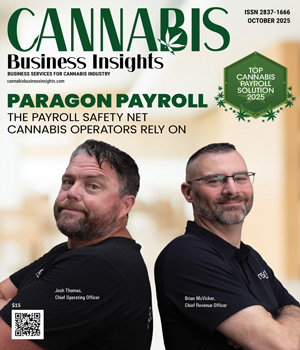
 Josh Thomas, Chief Operating Officer, Brian McVicker, Chief Revenue Officer
It enables cannabis operators to carry out payroll and banking with confidence, replacing the uncertainty of compliance and finance with stability, delivered without the inflated costs of a ‘cannabis premium.’
Mainstream payroll solution providers have long refused cannabis operators, leaving the industry underserved. The few that engage use off-the-shelf systems designed for traditional industries that break down under state-by-state rules and cannabis-specific compliance. This leads to reporting errors, tax penalties and little support when regulations shift. Banking access is just as unstable. Many operators are denied accounts, and those who secure them often face sudden freezes or closures that leave payroll and taxes unfunded.
 Paragon Payroll addresses these challenges head-on. Initially serving a broad range of industries, the company pivoted after being approached by a cannabis operator who had been rejected by every other provider. Recognizing a systemic gap, it committed to providing long-term support by hiring specialists who understand cannabis compliance and tax rules, and onboarding staff who make sure clients are correctly set up in the payroll system from day one. It also built an in-house treasury team to manage payroll funding and secured banking relationships that gave cannabis operators dependable access to financial services. This integrated approach protects clients from payroll disruptions and sudden account closures.
“We came into the cannabis space not for profit, but to support operators with compassion and care, giving them a partner they can trust,” says Brian McVicker, chief revenue officer.
Serving a diverse range of cannabis operators from dispensaries and cultivators to processors and multi-state businesses, Paragon Payroll’s platform is powered by isolved, one of the fastest-growing HCM systems in the U.S. It simplifies payroll across entities, adapts to state-specific tax rules and integrates timekeeping to give operators more control. With built-in flexibility, clients can focus on growth while staying ahead of complexity and regulatory pressures.
Payroll Stability Built on Compassion and Care
While technology plays a key role, Paragon Payroll’s responsive, human-centered support drives results. When businesses face tight deadlines and regulatory challenges, it ensures immediate access to expert help. It is small enough to care, big enough to deliver, providing the personal attention clients rely on with the capacity to resolve complex challenges at scale.
In-house specialists answer 95 percent of client calls, with 87 percent handled in 30 seconds or less, ensuring immediate support with audits, vendor disputes and shifting regulations.
“We empower cannabis operators with knowledge and tools that demystify compliance and reduce risk,” says McVicker.
The commitment to fast, expert support proved invaluable for a West Coast cannabis manufacturer. Its HR manager handled onboarding, terminations, benefits and payroll alone, and the workload was overwhelming. When their mainstream provider abruptly gave 30 days to transition out, she turned to her CPA, who referred Paragon Payroll.
We bring the voices of real cannabis businesses directly to policymakers because we know what’s at stake; livelihoods, licenses and the industry's future
The account was quickly stabilized, compliance problems were sorted and payroll was restored. That intervention changed what could have been a devastating setback into a turning point. Impressed by the stability and guidance a partner with industry expertise could deliver, she later joined the Paragon to provide support to operators navigating similar challenges.
Smart Tools and Training to Stay Ahead of Compliance
Clients are protected before challenges escalate into crises. Most founders and HR leads in cannabis are experts in cultivation, retail or operations, but not in compliance. To bridge this knowledge gap, Paragon offers practical tools designed specifically for the industry’s regulatory realities.
Its online learning center addresses critical but often overlooked questions, such as what qualifies as employee misclassification in cannabis, how to respond to wage garnishment notices and how Section 280E impacts incentive pay. These resources are written in clear, actionable language and are available to everyone, not just Paragon’s clients. This open-access reflects its belief that strengthening cannabis compliance across the board makes the ecosystem more stable and resilient.
-
We came into the cannabis space not for profit, but to support operators with compassion and care, giving them a partner they can trust
To further support HR teams and frontline managers, it developed Canna U, a learning platform designed to meet the pace and complexity of cannabis operations. Canna U’s on-demand, self-guided coursed gives businesses a practical way to prepare new hires for payroll and HR tasks. It also helps companies strengthen retention and keep operations aligned with evolving laws and business models. The content is created in collaboration with educational experts and regularly updated to reflect the latest changes in labor regulations, payroll practices, and workplace expectations. Whether operators are scaling across state lines or opening their first storefront, Canna U gives them the tools to stay prepared and aligned.
 Paragon Payroll also plays a major role in actively shaping professional standards, building community, and creating new paths to recognition in the cannabis space.
One of its most visible contributions is the Cannabis HR Summit, an annual gathering designed to bring HR professionals out of isolation and into collaboration. In many cannabis companies, HR leaders wear every hat, handling onboarding, terminations, compliance, benefits and employee relations with little outside support. The summit creates space for these professionals to connect, share challenges, and exchange best practices with others who understand the distinct demands of the industry.
By partnering with the Society for Human Resource Management (SHRM), Paragon allows attendees to earn formal recertification credits. It is the first program in the cannabis space and marks a meaningful step toward professional legitimacy across the workforce. SHRM’s involvement brings national recognition to the Summit and validates the strategic role HR professionals play in cannabis.
Shaping Policy and Elevating Industry Standards
Paragon Payroll also plays a hands-on role in national cannabis policy. Team members serve on both the HR and Finance & Banking committees at the National Cannabis Industry Association (NCIA), helping shape guidance on labor, compliance and financial normalization. With a seat on the board of the Independent Payroll Providers Association (IPPA), it advocates for fair treatment of cannabis businesses within the broader payroll and banking ecosystem.
This work isn’t symbolic; it’s personal. During NCIA’s Capitol Hill Days, Paragon Payroll leaders walked the halls of Congress to share firsthand accounts from cannabis operators. Some had lost payroll access mid-cycle, vendors had dropped others without warning and many had faced penalties due to outdated rules. These disruptions didn’t just cause inconvenience; they put paychecks, compliance and business stability at risk.
Paragon brought these stories to lawmakers, pushing for fairer treatment and clearer regulation. It continues to be involved in advocacy efforts, knowing that policy decisions directly affect the day-to-day operations of its clients.
“Advocacy isn’t just something we do, it’s part of who we are. We bring the voices of real cannabis businesses directly to policymakers because we know what’s at stake; livelihoods, licenses and the industry's future,” says Clarke Lyons, brand marketing manager.
That level of service reflects more than process, it reflects culture. Paragon has worked deliberately to build a team that understands the cannabis space and cares deeply about showing up for clients when it matters most. It invests in leadership development, ongoing training and communication practices that give employees the tools and autonomy to quickly solve problems.
Paragon Payroll is preparing clients for the next wave of industry change, from new state markets to federal policy shifts, as well as promoting reliable access to banking and payroll services. It is building a reliable ecosystem of support, giving cannabis operators the tools, training and advocacy they need to succeed in a challenging industry.
Choosing Cannabis Payroll Infrastructure Under Regulatory Volatility
Payroll failures inside cannabis businesses rarely begin with payroll itself. The breakdown usually starts when a dispensary, cultivator or manufacturer expands faster than its administrative systems can absorb. A retail group opens additional locations across multiple states. A processor hires seasonal labor without clear classification controls. An operator gets dropped by a traditional banking or payroll provider with thirty days’ notice after a compliance review. The immediate disruption lands on payroll teams, but the underlying issue is instability around infrastructure, documentation and institutional support.
Cannabis operators now face a labor environment that resembles mainstream retail and manufacturing while still functioning under fragmented state oversight and federal uncertainty. Tax notices, onboarding errors and payment interruptions carry heavier consequences when licensing status can hinge on administrative accuracy. Payroll vendors that rely on generalized implementation models often struggle once multi-state tax handling, cannabis-specific banking complications or emergency payroll remediation enters the picture. Buyers evaluating providers increasingly scrutinize responsiveness during escalation events rather than polished software demonstrations.
Support depth has become more important than feature breadth. Many cannabis HR leads still operate as departments of one, balancing hiring, onboarding, disciplinary issues and regulatory reporting simultaneously. That creates little tolerance for outsourced call-center structures or delayed ticketing systems when payroll errors emerge. Several operators also entered legal cannabis from legacy markets or adjacent industries without institutional HR experience. The gap frequently appears in worker classification, tax administration and documentation management rather than employee scheduling or standard payroll automation.
Implementation methodology matters more than many operators initially assume. Cannabis companies changing payroll vendors are often doing so reactively after account closures, compliance concerns or service failures. Compressed migration timelines expose weaknesses quickly. Providers that depend heavily on templated onboarding can create downstream reporting inconsistencies that become visible months later during audits or licensing reviews. Buyers increasingly prioritize teams capable of adapting onboarding workflows to different ownership structures, expansion plans and state-specific labor requirements.
Pricing structures have also become a proxy for trust. Cannabis businesses remain accustomed to elevated fees attached solely to their industry status, particularly around banking, payment processing and insurance administration. Several payroll providers continue to layer cannabis-specific surcharges onto standard HCM functions. That approach has created skepticism among operators already managing volatile margins and inconsistent cashflow conditions.
Educational support has quietly become another differentiator. New licensees frequently inherit complex employment obligations without internal expertise to interpret them. Payroll providers now occupy a quasi-advisory role whether they intend to or not. Buyers increasingly favor firms capable of supplying accessible compliance guidance, onboarding education and labor-related documentation resources before problems surface. The strongest providers understand that many operators do not know which questions they should ask until penalties arrive.
Within that environment, Paragon Payroll stands out through its concentration on cannabis-specific payroll administration paired with in-house tax, treasury and implementation support. The company supports dispensaries, cultivators, manufacturers and multi-state operators using HCM infrastructure customized for cannabis employment conditions rather than generic payroll deployment. Its operating model emphasizes direct human support during emergent payroll situations, including tax notices, banking disruptions and onboarding transitions.
The company also maintains educational resources for cannabis employers navigating labor compliance, employee classification and HR administration. That combination becomes particularly relevant for operators managing rapid hiring, fragmented state requirements or unstable vendor relationships. Paragon’s long-term focus on cannabis payroll, combined with its refusal to impose cannabis-specific premium pricing structures, makes it a credible choice for executives prioritizing continuity, responsiveness and administrative stability inside an industry still defined by volatility.
...Read more
Company : Paragon Payroll
ManagementJosh Thomas, Chief Operating Officer, Brian McVicker, Chief Revenue Officer