

Thank you for Subscribing to Cannabis Business Insights Weekly Brief


In a tight-margin cannabis market, businesses are often pushed to spend more on marketplaces to drive performance, yet many see limited returns. The gap lies in how effectively listings are managed and positioned.
Sparks Cannabis operates on the retailer’s side, taking full ownership of listing management to align marketplace activity with business outcomes rather than platform-driven spend. It helps cannabis dispensaries, delivery operators and brands optimize their presence across platforms, improving conversion efficiency and cost per acquisition.
“We let our partners focus on selling products and serving customers while we handle the complexities of cannabis marketplaces,” says Kevin Sparks, CEO.
With firsthand industry experience, Kevin gained insights into how listings were structured and promoted behind the scenes. While businesses were guided toward higher spend, customer positioning was often overlooked, leading him to focus on the operational levers that drive performance beyond spend, from listing accuracy to platform-specific optimization.
Where Spend Meets Strategy
In cannabis marketplaces, businesses often get lost in understanding how positions, pricing and presentation interact, leading to higher spending.
 Sparks ensures that every ad purchase, promotion or listing feature is strategically selected and executed. Its proprietary analytics dashboard measures returns and sets clear health benchmarks, focusing on cost per user and efficiency rather than just traffic numbers. The team manages all negotiations for paid placements to ensure optimal value, freeing up clients to serve customers.
It also oversees non-paid features like promo codes and sales pricing. Deals are promoted, and products are verified at scale across platforms, with hundreds of items manually maintained and continuously updated to ensure menus remain accurate and up to date. By taking over these operations, Sparks ensures that listings are optimized and consistently performing.
To track real-time revenue, it integrates with major point-of-sale systems, including Treez and Dutchie. Retailers gain clear visibility into marketplace activity to make informed decisions and optimize spend.
Its dashboard aggregates online reviews across platforms. As one of the few cannabis partners recognized by Yelp, it manages reviews at no extra cost, saving businesses the fees they previously paid. Sparks’ team monitors and responds to reviews while alerting the client’s staff to negative feedback, improving overall engagement. It also continuously tracks metrics and competitors, meeting regularly with clients to adjust listings.
The Operational Mechanics of Marketplace Performance
Presentation plays a critical role in online marketplace conversion. Sparks’ graphic design team handles deal graphics, cover images, logos, avatars, display ads and hero banners. Combining optimized ad positions with high-quality visuals allows retailers to present consistent and conversion-oriented brand information.
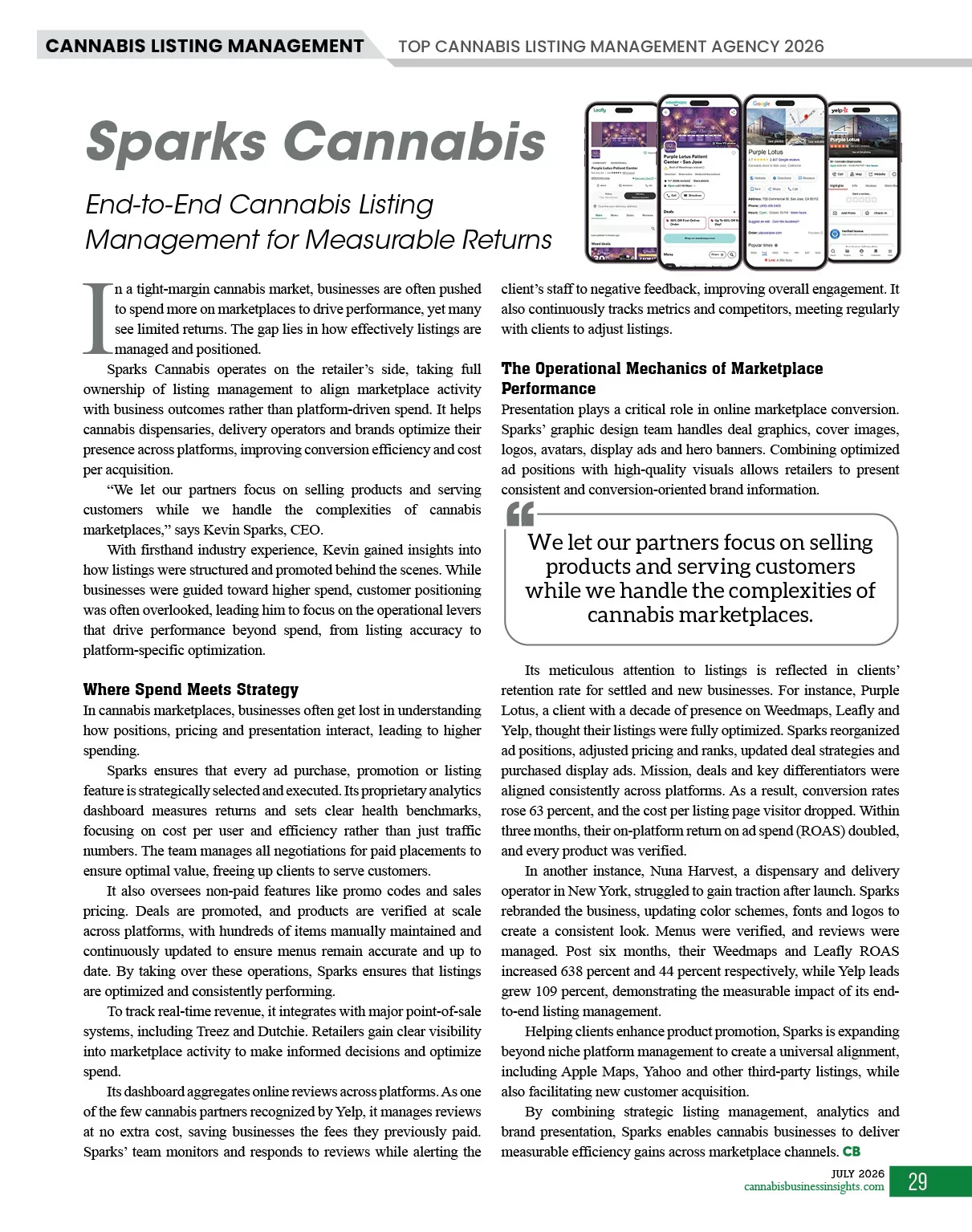
Its meticulous attention to listings is reflected in clients’ retention rate for settled and new businesses. For instance, Purple Lotus, a client with a decade of presence on Weedmaps, Leafly and Yelp, thought their listings were fully optimized. Sparks reorganized ad positions, adjusted pricing and ranks, updated deal strategies and purchased display ads. Mission, deals and key differentiators were aligned consistently across platforms. As a result, conversion rates rose 63 percent, and the cost per listing page visitor dropped. Within three months, their on-platform return on ad spend (ROAS) doubled, and every product was verified.
In another instance, Nuna Harvest, a dispensary and delivery operator in New York, struggled to gain traction after launch. Sparks rebranded the business, updating color schemes, fonts and logos to create a consistent look. Menus were verified, and reviews were managed. Post six months, their Weedmaps and Leafly ROAS increased 638 percent and 44 percent respectively, while Yelp leads grew 109 percent, demonstrating the measurable impact of its end-to-end listing management.
Helping clients enhance product promotion, Sparks is expanding beyond niche platform management to create a universal alignment, including Apple Maps, Yahoo and other third-party listings, while also facilitating new customer acquisition.
By combining strategic listing management, analytics and brand presentation, Sparks enables cannabis businesses to deliver measurable efficiency gains across marketplace channels.
Sparks Cannabis operates on the retailer’s side, taking full ownership of listing management to align marketplace activity with business outcomes rather than platform-driven spend. It helps cannabis dispensaries, delivery operators and brands optimize their presence across platforms, improving conversion efficiency and cost per acquisition.
“We let our partners focus on selling products and serving customers while we handle the complexities of cannabis marketplaces,” says Kevin Sparks, CEO.
With firsthand industry experience, Kevin gained insights into how listings were structured and promoted behind the scenes. While businesses were guided toward higher spend, customer positioning was often overlooked, leading him to focus on the operational levers that drive performance beyond spend, from listing accuracy to platform-specific optimization.
Where Spend Meets Strategy
In cannabis marketplaces, businesses often get lost in understanding how positions, pricing and presentation interact, leading to higher spending.
Sparks ensures that every ad purchase, promotion or listing feature is strategically selected and executed. Its proprietary analytics dashboard measures returns and sets clear health benchmarks, focusing on cost per user and efficiency rather than just traffic numbers. The team manages all negotiations for paid placements to ensure optimal value, freeing up clients to serve customers.It also oversees non-paid features like promo codes and sales pricing. Deals are promoted, and products are verified at scale across platforms, with hundreds of items manually maintained and continuously updated to ensure menus remain accurate and up to date. By taking over these operations, Sparks ensures that listings are optimized and consistently performing.
To track real-time revenue, it integrates with major point-of-sale systems, including Treez and Dutchie. Retailers gain clear visibility into marketplace activity to make informed decisions and optimize spend.
-
We let our partners focus on selling products and serving customers while we handle the complexities of cannabis marketplaces.
Its dashboard aggregates online reviews across platforms. As one of the few cannabis partners recognized by Yelp, it manages reviews at no extra cost, saving businesses the fees they previously paid. Sparks’ team monitors and responds to reviews while alerting the client’s staff to negative feedback, improving overall engagement. It also continuously tracks metrics and competitors, meeting regularly with clients to adjust listings.
The Operational Mechanics of Marketplace Performance
Presentation plays a critical role in online marketplace conversion. Sparks’ graphic design team handles deal graphics, cover images, logos, avatars, display ads and hero banners. Combining optimized ad positions with high-quality visuals allows retailers to present consistent and conversion-oriented brand information.
Its meticulous attention to listings is reflected in clients’ retention rate for settled and new businesses. For instance, Purple Lotus, a client with a decade of presence on Weedmaps, Leafly and Yelp, thought their listings were fully optimized. Sparks reorganized ad positions, adjusted pricing and ranks, updated deal strategies and purchased display ads. Mission, deals and key differentiators were aligned consistently across platforms. As a result, conversion rates rose 63 percent, and the cost per listing page visitor dropped. Within three months, their on-platform return on ad spend (ROAS) doubled, and every product was verified.
In another instance, Nuna Harvest, a dispensary and delivery operator in New York, struggled to gain traction after launch. Sparks rebranded the business, updating color schemes, fonts and logos to create a consistent look. Menus were verified, and reviews were managed. Post six months, their Weedmaps and Leafly ROAS increased 638 percent and 44 percent respectively, while Yelp leads grew 109 percent, demonstrating the measurable impact of its end-to-end listing management.
Helping clients enhance product promotion, Sparks is expanding beyond niche platform management to create a universal alignment, including Apple Maps, Yahoo and other third-party listings, while also facilitating new customer acquisition.
By combining strategic listing management, analytics and brand presentation, Sparks enables cannabis businesses to deliver measurable efficiency gains across marketplace channels.
Rethinking Growth Levers in Cannabis Marketplace Listings
Cannabis retailers operate in a fragmented digital environment where visibility is shaped less by presence and more by precision. Listings across platforms such as Weedmaps, Leafly, Yelp and Google act as primary acquisition channels, yet many operators treat them as static placements rather than evolving commercial assets. This disconnect becomes costly in an industry already constrained by tight margins, where inefficient spend and inconsistent presentation dilute return without clear attribution.
A persistent misconception continues to influence decision-making: higher advertising spend is assumed to translate directly into stronger performance. In practice, marketplaces reward structured inputs rather than raw budget. Listings that are actively maintained, strategically positioned and consistently aligned across platforms tend to outperform those that rely on paid placement alone. The difference lies in how each element—menu accuracy, deal visibility, brand consistency and user engagement—is managed over time. Passive listings decay quickly, while actively curated ones compound value.
This introduces a more disciplined lens for evaluating listing management partners. The first signal lies in how effectively spend is translated into measurable outcomes. Visibility metrics alone offer limited insight; what matters is the relationship between cost and customer acquisition. Vendors that anchor decisions in efficiency benchmarks rather than surface-level traffic indicators allow executives to assess whether each dollar contributes to sustainable growth.
Equally important is the ability to manage the operational depth of listings. Cannabis menus are complex and dynamic, often involving hundreds of products that require continuous verification and updates across multiple platforms. Inconsistent or outdated information weakens consumer trust and suppresses conversion rates. Effective management extends beyond basic maintenance to include deal structuring, feature utilization and ongoing optimization of how products are presented to end users. This is not a one-time setup but a continuous process that demands both attention and systematization.
Brand coherence across marketplaces forms another critical layer. Disparate messaging, inconsistent visuals and misaligned promotions create friction in the customer journey. A retailer may appear differently on each platform, fragmenting its identity and reducing recall. Aligning these touchpoints into a unified narrative strengthens positioning and improves conversion by presenting a consistent value proposition regardless of where the customer engages.
Technology integration further separates superficial management from performance-driven execution. Access to unified analytics that connects listing activity with actual transaction outcomes provides clarity that many operators lack. Without this visibility, optimization remains reactive and often misguided. Integrations with point-of-sale systems and cross-platform data aggregation enable a more accurate understanding of return, allowing teams to adjust strategy based on real performance rather than assumptions.
Sparks Cannabis reflects this shift toward disciplined, effort-led listing management. It approaches listings as active revenue channels rather than static profiles, focusing on how inputs translate into measurable efficiency rather than increased spend. It manages advertising decisions alongside full listing maintenance, including menu verification, deal structuring and feature optimization, ensuring that each element contributes to performance.
Its proprietary analytics environment connects platform activity with real outcomes, while integrated review management and design support align brand presentation across channels. For executives seeking to stabilize acquisition costs while improving listing-driven revenue, it presents a model grounded in control, consistency and measurable return.
...Read more
